Crystallized Evergreen Branches: A Simple Winter Science Project for Your Homeschool
Winter invites us to slow down and look more closely at the world outside our windows. An easy way to bring some of that beauty indoors is by making crystallized evergreen branches. If there’s one thing I love to do in our homeschool, it’s crystallize things. My children are always amazed and it’s a lesson that’s never fallen short.
What You’ll Need
Borax (3 tablespoons per cup of water)
Boiling water
A mason jar
A small evergreen branch
Twine
A popsicle stick or pencil
How to Make Crystallized Evergreen Branches
1. Prepare the branch
Cut a small piece of evergreen and tie twine around the top to make a loop. Slide a popsicle stick or pencil through the loop so the branch can hang in the jar without touching the sides.
2. Mix the borax
Bring water to a boil. Add the borax to an empty mason jar.
3. Create the solution
Pour the boiling water into the jar and stir until the borax dissolves. The liquid will look cloudy because the water is fully saturated. It can’t absorb any more borax, and that’s what allows crystals to form later.
4. Submerge the branch
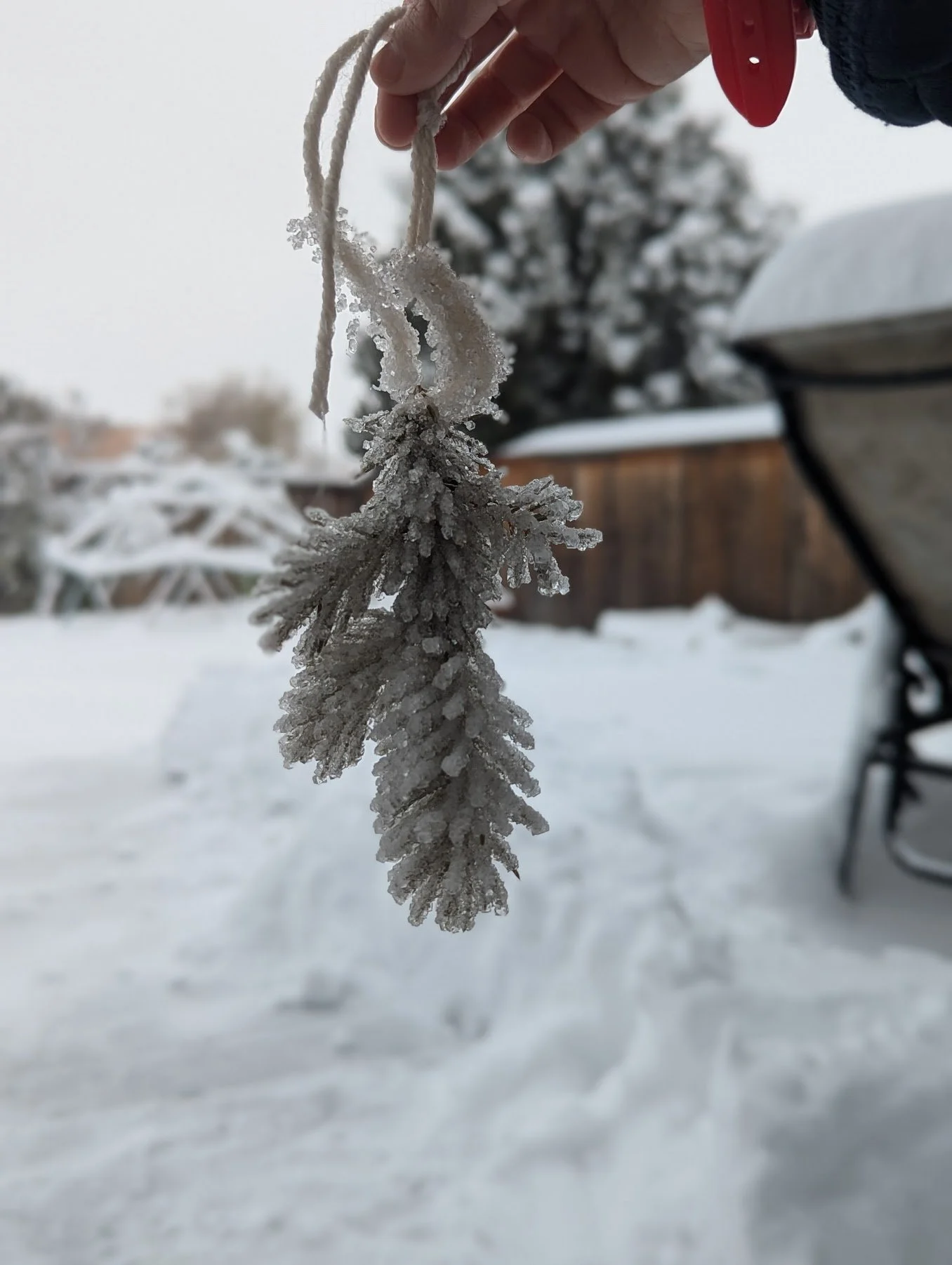
Lower the evergreen into the jar so it is completely covered. Set the jar somewhere it won’t be bumped. Over the next several hours, crystals will begin to grow along every needle and twig. By morning, you’ll have a frosted winter branch worthy of your nature shelf.
Charlotte Mason believed that children learn science best through direct contact with real things. Books and narrations give language and ideas, but experiments like this one strengthen understanding through close attention.
A project like crystallizing an evergreen branch gives a child a moment to observe cause and effect. They see what saturation looks like. They notice how crystals build patterns. They encounter scientific terms in their proper context rather than memorizing definitions.
Afterward, a short narration helps the child sort what they’ve seen. They might describe the steps, the changes in the water, or how the branch looked before and after. Mason didn’t separate the hands-on from the living idea. Both matter. Reading a chapter on crystals, watching them grow overnight, and telling back the experience reinforces curiosity and skill.
These small experiments don’t replace nature walks or living books, but they hold a place in a broad science education. They remind children that the world is orderly, surprising, and worth studying. And they give mothers a way to keep science simple without losing depth.
If you try this one, take a moment to look closely at the finished branch before setting it on the shelf. You may find yourself narrating right alongside your child.